Written by Ibn Muhammad
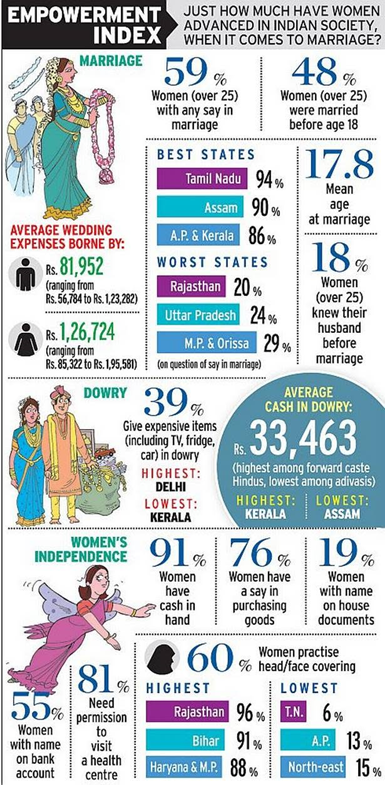
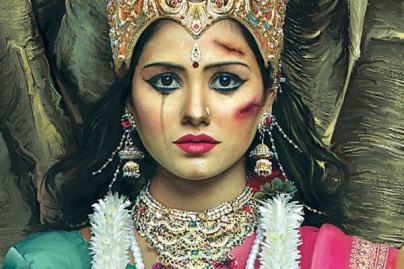
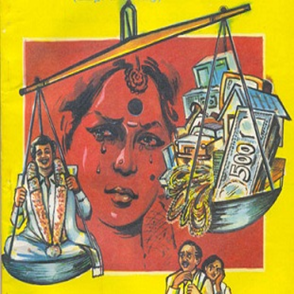
Newspapers in India carry reports of rape and burning of women for not bringing sufficient dowry or their inability to satisfy the demands of greedy in-laws. The Indian National Crime Records Bureau (NCRB) reports that there were about 8172 dowry death cases registered in India in 2008 [1]. Dowry (known as Dahejin Hindi) has been traditionally practiced in the Hindu society since centuries. Dowry is given by the parents of the girl and it consists of various household things like dresses, ornaments, electrical goods, bedroom furniture, etc. at the time of the marriage. Additionally, rich people also give cash, car, property or land as part of dowry. But for middle class people, and those who are not so well off, the custom of dowry has become an evil. Ordinary people with average wages spend all their savings in preparation of a dowry for their daughter to take with her after her marriage. The Indian government has banned giving and accepting dowry in Hindu marriage. This article will give historic background to the age old tradition of dowry in Hindu marriage.
Dowry in Hindu Scriptures
Vedas are considered as the oldest Hindu texts. Several passages in the Vedas make mention of dowry in Hindu marriages.Rigveda Mandal 1, Suktas 125 and 126 talk of the dowry King Swanaya paid to Kakshivat on the marriage of his daughter with him. Rigveda 1/126/2-3 mentions,
शतं राज्ञो नाधमानस्य निष्काञ्छतमश्वान परयतान सद्य आदम |
शतं कक्षीवानसुरस्य गोनां दिवि शरवो.अजरमा ततान ||
उप मा शयावाः सवनयेन दत्ता वधूमन्तो दश रथासोस्थुः |
षष्टिः सहस्रमनु गव्यमागात सनत कक्षीवानभिपित्वे अह्नाम ||
“From which generous prince, soliciting (my acceptance), I, Kakshivat, unhesitatingly accepted a hundred nishkas, a hundred vigorous steeds, and a hundred bulls, whereby he has spread his imperishable fame through heaven. Ten chariots drawn by bay steeds, and carrying my wives, stood near me, given me by Swanaya ; and a thousand and sixty cows followed : these, after a short interval of time, did Kashivat deliver (to his father).”
The legend which is cited by the commentator of the four Vedas, Acharya Sayana, relates that Kakshivat, having finished his course of study, and taken leave of his preceptor, was journeying homewards, when night came on, and he fell asleep by the roadside: early in the morning, Raja Swanaya, the son of Bhavayavya, attended by his retinue, came to the spot, and disturbed the Brahmin’s slumbers: upon his starting up, the Raja addressed him with great cordiality, and being struck by his personal appearance, determined, if he was of suitable rank and birth, to give him his daughters in marriage. After ascertaining his fitness, he took Kakshivat home with him, and there married him to his ten daughters, presenting him at the same time with a hundred ‘nishkas’ of gold, a hundred horses, a hundred bulls, one thousand and sixty cows, and eleven chariots, one for each of his wives and one for himself, each drawn by four horses. With these presents Kakshivat returned home, and placed them at the disposal of his father, Dirghatamas.
This evidence is corroborated by Rishi Shaunaka’s Brhaddevata which also repeats these mantras explaining their purport.Brhaddevata 3/146-150 says,
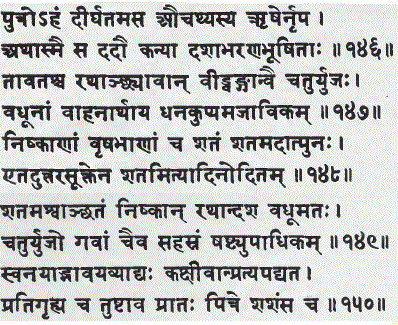
‘I am a son of the seer Dirghatamas, son of Ucathya, O king.’ Thereupon he (Swanaya) gave him ten maidens decked with ornaments. and the same number of chariots, strong-bodied bay steeds going in teams of four, for the purpose of conveying the maidens, money and (utensils of) inferior metal, goats and sheep. Further he gave (him) a hundred necklets and a hundred bulls. This is told in the next hymn with (the stanza) ‘A hundred’ and so forth. A hundred horses, a hundred necklets, ten chariots with maidens, (steeds) going in teams of four, and a thousand and sixty cows.Kakshivat, who obtained (all this) from Swanaya Bhavayavya, both praised (him) after receiving (it) and recited (the hymn) ‘At morn’ to his father.
This reference besides proving the existence of Polygamy in Vedic society, also shows the prevalence of dowry in that society.
Rigveda Mandal 10, Sukta 85 as well as Atharvaved Kaand 14, Suktas 1 and 2, contain details about the Hindu marriage ceremony. Verses from these hymns are chanted during Hindu wedding ceremonies. Rigveda 10/85/13 and Atharvaved 14/1/13 talking of the wedding season says,
सूर्याया वहतुः प्रागात्सविता यमवासृजत् |
अघासुहन्यन्ते गावो.अर्जुन्योः पर्युह्यते ||
“Surya’s bridal procession which Savita despatched has advanced; the oxen are whipped along in the Magha (constellations); she is borne (to her husband’s house) in the Arjuni (constellations).”
The purport of this mantra is that the Dowry (in this case the oxen) must reach the husband’s home before the bride is escorted there.The next two mantras describe that two men from the bride’s family must take this Dowry to the husband’s home well before the wedding ceremony. For more details about the process of giving Dowry refer to the commentary of Arya Samaj scholar Sripad Damodar Satvalekar on these mantras (Atharvaveda ka Subodh Bhashya Kaand 14).
This system of Dowry has continued since Vedic times till today. Other Hindu texts contain detailed accounts of dowry. For example, Mahabharata Adi Parv Section 197/ Shlokas 15-18 provide details of the dowry presented by King Drupada on the marriage of his daughter Kṛṣṇā Draupadi with the five Pandavas (Polyandry).
15 कृते विवाहे दरुपदॊ धनं ददौ; महारथेभ्यॊ बहुरूपम उत्तमम
शतं रथानां वरहेमभूषिणां; चतुर्युजां हेमखलीन मालिनाम
16 शतं गजानाम अभिपद्मिनीं तथा; शतं गिरीणाम इव हेमशृङ्गिणाम
तथैव दासी शतम अग्र्ययौवनं; महार्हवेषाभरणाम्बर सरजम
17 पृथक पृथक चैव दशायुतान्वितं; धनं ददौ सौमकिर अग्निसाक्षिकम
तथैव वस्त्राणि च भूषणानि; परभावयुक्तानि महाधनानि
18 कृते विवाहे च ततः सम पाण्डवाः; परभूतरत्नाम उपलभ्य तां शरियम
विजह्रुर इन्द्र परतिमा महाबलाः; पुरे तु पाञ्चाल नृपस्य तस्य ह
“After the weddings were over, king Drupada gave unto those mighty car-warriors diverse kinds of excellent wealth. And the king gave unto them one hundred cars with golden standards, each drawn by four steeds with golden bridles. And he gave them one hundred elephants all possessing auspicious marks on their temples and faces and like unto a hundred mountains with golden peaks. He also gave them a hundred female servants all in the prime of youth and clad in costly robes and ornaments and floral wreaths. And the illustrious monarch of the Lunar race gave unto each of those princes of celestial beauty, making the sacred fire a witness of his gifts, much wealth and many costly robes and ornaments of great splendour. The sons of Pandu endued with great strength, after their wedding were over, and after they had obtained Krishna like unto a second Sri along with great wealth, passed their days in joy and happiness, like so many Indras, in the capital of the king of the Panchalas.”
The Mahabharata also informs us of dowry given during the marriage of Abhimanyu, son of Arjuna with Uttara, daughter of King Viraat. Mahabharata Virat Parv, section 72, shlokas 36-37 say
36 तस्मै सप्त सहस्राणि हयानां वातरंहसाम
दवे च नागशते मुख्ये परादाद बहुधनं तदा
37 हुत्वा सम्यक् समिद्धाग्निमर्चयित्वा द्विजन्मः
राज्यं बलं कोशं च सर्वमात्मानमेव च
And Virata then gave him (as dowry) seven thousand steeds endued with the speed of the wind and two hundred elephants of the best kind and much wealth also. And having duly poured libations of clarified butter on the blazing fire, and paid homage unto the twice-born ones, Virata offered to the Pandavas his kingdom, army, treasury, and his own self.
Mahabharata Adi Parv section 220 details the dowry provided by Krishna and Balrama on the marriage of their sister Subhadra.
| तेषां ददौ हृषीकेशो जन्यार्थे धनमुत्तमम्। हरणं वै सुभद्राया ज्ञातिदेयं महायशाः।। |
| रथानां काञ्चनाङ्गानां किङ्किणीजालमालिनाम्। चतुर्युजामुपेतानां सूतैः कुशलशिक्षितैः।। |
| सहस्रं प्रददौ कृष्मो गवामयुतमेव च। श्रीमान्माथुरदेश्यानां दोग्ध्रीणां पुण्यवर्चसाम्।। |
| बडवानां च शुद्धानां चन्द्रांशुसमवर्चसाम्। ददौ जनार्दनः प्रीत्या सहस्रं हेमभूषितम्।। |
| तथैवाश्वतरीणां च दान्तानां वातरंहसाम्। शतान्यञ्जनकेशीनां श्वेतानां पञ्चपञ्च च।। |
| स्नानपानोत्सवे चैव प्रयुक्तं वयसान्वितम्। स्त्रीणां सहस्रं गौरीणां सुवेषाणां सुवर्चसाम्।। |
| सुवर्णशतकण्ठीनामरोमाणां स्वलङ्कृताम्। परिचर्यासु दक्षाणां प्रददौ पुष्करेक्षणः।। |
| पृष्ठ्यानामपि चाश्वानां बाह्लिकानां जनार्दनः। ददौ शतसहस्राख्यं कन्याधनमनुत्तमम्।। |
| कृताकृतस्य मुख्यस्य कनकस्याग्निवर्चसः। मनुष्यभारान्दाशार्हो ददौ दश जनार्दनः।। |
| गजानां तु प्रभिन्नानां त्रिधा प्रस्रवतां मदम्। गिरिकूटनिकाशानां समरेष्वनिवर्तिनाम्।। |
| क्लृप्तानां पटुघण्टानां चारूणां हेममालिनाम्। हस्त्यारोहैरुपेतानां सहस्रं साहसप्रियः।। |
| रामः पाणिग्रहणिकं ददौ पार्थाय लाङ्गली। प्रीयमाणो हलधरः संबन्धं प्रति मानयन्।। |
Then Hrishikesa of great renown gave unto the party of the bridegroom much wealth. And unto Subhadra he gave the nuptial presents that had been given to her by her relatives. Krishna gave unto the Pandavas a thousand cars of gold furnished with rows of bells, and unto each of which were put four steeds driven by well-trained charioteers. He also gave unto them ten thousand cows belonging to the country of Mathura, and yielding much milk and all of excellent colour. Well-pleased, Janardana also gave them a thousand mares with gold harnesses and of colour white as the beams of the moon. He also gave them a thousand mules, all well-trained and possessing the speed of the wind, of white colour with black manes. And he of eyes like lotus-petals also gave unto them a thousand damsels well-skilled in assisting at bathing and at drinking, young in years and virgins all before their first-season, well-attired and of excellent complexion, each wearing a hundred pieces of gold around her neck, of skins perfectly polished, decked with every ornament, and well-skilled in every kind of personal service. Janardana also gave unto them hundreds of thousands of draft horses from the country of the Valhikas as Subhadra’s excellent dower. That foremost one of Dasarha’s race also gave unto Subhadra as her peculiumten carrier-loads of first class gold possessing the splendour of fire, some purified and some in a state of ore. And Rama having the plough for his weapon and always loving bravery gave unto Arjuna, as a nuptial present, athousand elephants with secretions flowing in three streams from the three parts of their bodies (the temple, the ears, and the anus) each large as a mountain summit, irresistible in battle, decked with coverlets and bells, well-adorned with other golden ornaments, and equipped with excellent thrones on their backs.
[Mahabharata Adiparv 220 Haranaharana parv, sholkas 44-55, printed by Gita Press Gorakhpur]
It also reveals that slaves, especially women, were given as a part of the dowry to the bridegroom. In simple language, it meant commercialisation of women. Now let us turn to Ramayana and the dowry given by King Janaka on the marriage of Sita and Rama. Valmiki Ramayana mentions,
अथ राजा विदेहानां ददौ कन्याधनं बहु ।।
गवां शतसहस्राणि बहूनि मिथिलेश्वर:।
कम्बलानां च मुख्यानां क्षौमकोट्यंबराणि च ।।
हस्त्यश्वरथपादातं दिव्यरूपं स्वलङ्कृतम् ।
ददौ कन्यापिता तासां दासीदासमनुत्तमम् ।।
हिरण्यस्य सुवर्णस्य मुक्तानां विद्रुमस्य च।
ददौ परमसंहृष्ट: कन्याधनमनुत्तमम् ।।
Then that king Janaka of Mithila, the one from Videha lineage, gave innumerable patrimonial riches. He has also given umpteen number of cows, millions of excellent shawls and silk dresses, and elephants, horses, chariots, foot soldiers, besides hundreds of highly decorated girls, divine in their mien, as unexcelled chambermaids and handmaidens to the brides. Immensely pleased, king Janaka gave excellent ornaments made of fine gold, pearls and corals.
[Valmiki Ramayana Sarg 74; Shlokas 3-6]
All these passages show the extravagant spending in Hindu marriages and sadly these are the ideals people look upto. How can things improve when such people and events are made role models by the common folk?
Dowry in the writings of Hindu scholars
You will be surprised to know that even the so-called ‘reformist’ Hindu scholars consider Dowry as an ‘integral part’ of the Hindu marriage. The leading figure amongst them is Swami Dayanand Saraswati, the founder of the protestant cult of Arya Samaj. In his book Sanskar Vidhi he mentions the practice of dowry as being an integral part of the Hindu marriage. Ramgopal Vidyalankar of Gurukul Kangri has written a commentary on Sanskar Vidhi known as Sanskar Prakash. The following excerpt in Hindi is from Sanskar Prakash, 1984 Edition, Page 128
ऒ गौर्गोर्गोः प्रतिगृह्यताम – यह गाय है, लीजिये, गाय लीजिये
इस वाक्य से वर की विनती कर के अपनी शक्ति के योग्य वर को गोदानादी द्रव्य, जो वर को योग्य हों, अर्पण करे और वर ‘ओं प्रतिगृह्यतामि'(लाओ लेता हूं) इस वाक्य से उस को ग्रहण करे.
Translation:
ऒ गौर्गोर्गोः प्रतिगृह्यताम -This is a cow. Accept, please accept this cow.
With this sentence we request the groom to accept the cow and other materials in dowry, which are suitable for the groom and the groom accepts it by repeating the phrase ‘ओं प्रतिगृह्यतामि’ (Give; I am accepting)
These words clearly establish that Dowry is an integral part of Hindu marriage and the dowry must be suitable for the groom depending on his social status.
Pandit Bhimsen Sharma, the pupil of Swami Dayanand Saraswati, has even alloted a share of the dowry to the mother-in-law of the bride in his book Shodash Sanskar Vidhi.
After knowing all this information, we should realize where the source of dowry lies? To eradicate dowry Hindus need to discard these scriptures which are used to justify the evil of dowry and which inspire people to shamelessly demand dowry citing the example set by their scriptural ‘role-models’.
Footnotes:
[1] Figures at a Glance 2008. National Crime Records Bureau, Ministry of Home Affairs, Government of India, accessed on 16 Jun 2012. <http://ncrb.nic.in/CII2008/cii-2008/figure%20at%20a%20glance.pdf>.