Written by Ibn Muhammad
Every Sookt (hymn) of the Vedas has a distinct Devata (deity) and a Rishi (poet). The Devata of a Sookt is one whose praises have been sung in that Sookt. For example, the Rishi of the first ten hymns of Rigveda is Madhuchanda Vishvamitra and the Devata of the first hymn is Agni. The subsequent hymns have Vaayu, Indra, etc as their Devatas.
According to Nirukt, the authentic glossary of Vedas,
Deva is (so called) from making gifts (da) or from being brilliant (dip), from being radiant (dyut), or because his sphere is heaven. He who is called deva is also called devata. [Nirukt 7:15]
How important is it to know the Devata of a hymn? This can be evaluated from the following statement of Nirukt 7:4.
“The stanzas whose deity is not specified, such stanzas belong to the same deity to whom that particular sacrifice, or a part of the sacrifice, is offered. Now, elsewhere than the sacrifice, they belong to Prajapati according to the ritualists; and to Narasamsa according to the etymologists.”
The importance of Devatas can also be inferred from the fact that there is no Sookt in the Vedas which is not addressed to a Devata or in which supplication is not made to a Devata. The classical understanding of the Devatas is that they possess intellect and are superior to humans.
Number of Devatas, Their Categories and Their Attributes
In all four Vedas, nearly 400 Devatas have been mentioned. In common undertanding their number is said to be 330 million. Rigveda alone contains the names of 171 Devatas (see Devata Parichay, by Shri Damodar Satvalekar). The mention of 33 Devatas is found at many places in the Vedas, out of which, 11 are of the earth, 11 of mid-air and 11 of sky.
The number of Devatas generally found in Hindu Pantheon is 33. For example, Rigveda 1:34:11 says,
“Come, O Nasatyas, with the thrice-eleven Gods; come, O Asvins, to the drinking of the oblation. Make long our days of life, and wipe out all our sins: ward off our enemies; be with us evermore.”
Similarly it is mentioned in Rigveda 8:30:2,
आ नासत्या तरिभिर एकादशैर इह देवेभिर यातम मधुपेयम अश्विना |
परायुस तारिष्टं नी रपांसि मर्क्षतं सेधतं दवेषो भवतं सचाभुवा ||
“Thus be ye lauded, ye destroyers of the foe, ye Three-and-Thirty Deities, The Gods of man, the Holy Ones.” Rigveda 3:6:9
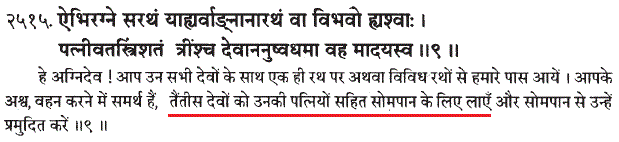
“Agni bring hither according to thy wont and gladden the three and thirty gods with their wives…”
A similar mantra is found in Atharvaved 20:13:4.
According to their places of residence, Devatas have been divided into three types.
- prithvisthaani or terrestrial e.g. Agni
- madhyasthaani or aerial e.g. Indra
- dyosthaani or celestial e.g. Surya
This classification is found in the Vedas as well as in Yaska’s Nirukta (7:5) where he says
“There are three deities according to the expounders of the Veda. viz. Agni, whose place is on the earth; Vayu, or Indra, whose place is in the air; and Surya (the sun), whose place is in the sky. These deities receive severally many appellations, in consequence of their greatness, or of the diversity of their functions.”
Rigveda 1:139:11 says,

“O ye Eleven Gods whose home is heaven, O ye Eleven who make earth your dwelling, Ye who with might, Eleven, live in waters, accept this sacrifice, O Gods, with pleasure.”
Rigveda 8:35:3 states,

“Aswins, associated with all the thrice eleven gods, with the Waters, the Maruts, the Bhrigus, and united with the Dawn and the Sun, drink the Soma.”
It is impossible to state with confidence who these 33 were, as not only was not the highest Hindu authority on this subject able to make up his mind with regard to it, but in these very mantras we see that the 33 did not include all the gods. We read of ‘ Agni and the 33 ;’ ‘the Aswins and the 33;’ ‘ the 33 and the Maruts, the Dawn, and the Sun all of whom were regarded and worshipped as distinct independent divinities. This number of thirty-three gods is in the Shatapatha Brahmana (iv. 5, 7, 2) explained ‘as made up of 8 Vasus, 11 Rudras, and 12 Adityas, together with Dyaus and Prithivi (Heaven and Earth), while Prajapati makes a thirty-fourth. However, in a contradictory description, of the same Shatapath Brahmana (xi, 6, 3, 5), Heaven and Earth are included in the Vasus, while Indra and Prajapati are the 32nd and 33rd respectively. Thus, there is no consistency in the accounts.
This enumeration could scarcely have been the one contemplated in the hymns, as we have seen that one of the texts above quoted (Rigveda 1:139:11) assigns eleven deities, who must probably have been all of the same class, to each of the three spheres, sky, air, and earth. It is also clear that this number of thirty-three gods could not have embraced the whole of the Vedic deities, as in some of the preceding texts Agni and the Asvins are separately specified, as if distinct from the thirty-three. Farther, Indra could not have been, in the opinion of the author of the Shatapath Brahmana, at least as expressed in this passage, xi. 6, 3, 5, one of the twelve Adityas (as he ‘was regarded at a later period), since he is separately specified as making up the number of thirty-three gods.
This number thirty three is not all. A much larger number is mentioned in other mantras as follows,

“Three times a hundred gods and thrice a thousand and three times ten and nine have worshipped Agni.” [Rigveda 3:9:9]
The same number is mentioned in Rigveda 10:52:6 and Shukla Yajurveda 33:7.
These devatas are not only residents on earth, air and sky but also dwell in various parts of plants and animals. For example, Atharvaveda 1:30:3 says,
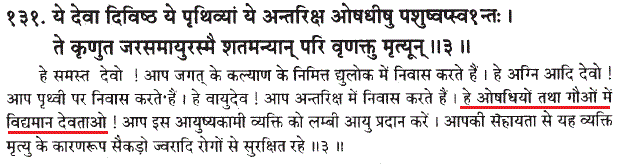
“All Gods who dwell on earth or in the heavens, in air, within the plants, the cows, the waters. Grant this man life to full old age, and let him escape the hundred other ways of dying.”
In another passage (Rigveda 1:27:13) the gods are spoken of as divided into great and small, young and old.

“Veneration to the great gods, veneration to the small gods : veneration to the young, veneration to the old. We worship (all) the gods as well as we are able; May I not omit the praise of the elder divinities.”
This distinction, however, is contradicted in another passage, Rigveda 8:30:1

“None of you, o gods, is small or young. You are all great.”
Origin of Devatas
In the Rigveda the Devatas are spoken of as immortal. For example Rigveda 1:24:1 says,

“Of whom, or of which divinity of the immortals, shall we invoke the auspicious name ? Who will give us to the great Aditi, that I may again behold my father and my mother?”
Rigveda 10:65:15 says,
देवान वसिष्ठो अम्र्तान ववन्दे ये विश्वा भुवनाभिप्रतस्थुः |
ते नो रासन्तामुरुगायमद्य यूयं पातस्वस्तिभिः सदा नः ||
“Immortal Gods have I, Vasistha, lauded, Gods set on high above all other beings. May they this day grant us widely-famed food: you Gods, preserve us evermore with blessings.”
The following references of Rigveda also mention gods as immortal. 1:72:2, 1:72:10, 1:189:3, 3:4:11, 3:21:1, 7:11:1 etc.
However, totally contradictory passages describe them as being the offspring of Heaven and Earth, as we shall see. In Rigved 1:113:19, Usha, the Dawn, is charaterized as the mother of all gods (devaanaam maataa).
माता देवानामदितेरनीकं यज्ञस्य केतुर्ब्र्हती वि भाहि |
परशस्तिक्र्द बरह्मणे नो वयुछा नो जने जनय विश्ववारे ||
In Rigved 2::26:3, Brahmanaspati is called their father (devaanaam pitaram).
स इज्जनेन स विशा स जन्मना स पुत्रैर्वाजं भरतेधना नर्भिः |
देवानां यः पितरमाविवासति शरद्धामना हविषा बरह्मणस पतिम ||
In Rigved 9:87:2, Soma is said to be the father and skilful GENERATOR of the gods (pitaa devaanaam janitaa sudakshah).
सवायुधः पवते देव इन्दुरशस्तिहा वर्जनं रक्षमाणः |
पिता देवानां जनिता सुदक्षो विष्टम्भो दिवो धरुणः पर्थिव्याः ||
In Rigved 9:96:5, the same deity is described as the generator of Heaven, Earth, Agni, Surya, Indra and Vishnu (janitaa divo janitaa prithviyaah janitaa Agner
janitaa Suryasya janitaa Indrasya janitota Vishnoh)
सोमः पवते जनिता मतीनां जनिता दिवो जनिता पर्थिव्याः |
जनिताग्नेर्जनिता सूर्यस्य जनितेन्द्रस्य जनितोत विष्णोः ||
The birth of Indra is mentioned in various places, speaking of his father and mother, thought they are not named. For example, Rigved 4:17:4 says
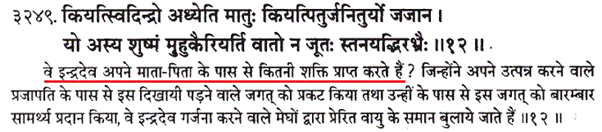
“Some portion of (his strength) Indra derives from his mother, some portion from his father: he who through his progenitor, has begotten (the world), and animates its vigour repeatedly, as the wind is driven by thundering clouds.”
See also Rigved 8:45:4; 8:66:1 and 10:134:1.
In Rigved 6:59:2, Indra and Agni are said to have had one generator and to be twin-brothers (samaano vaamjanitaa bhrataraa yuvam yamaav ihehamaataraa).


Atharvaved 1:30:2 speaks of some of the gods being fathers and others being sons (ye vo devaah pitaro ye cha putraah sachetaso me shrinuta idam uktam).
In Rigved 4:54:2 and Yajurved 33:54 it is said that Savitri bestows immortality on the gods (devebhyo hi prathamam yajniyebhyo amritatvam suvasi
bhaagam uttamam).
However, in Rigved 6:7:4, Agni, by his power or skill, is said to confer immortality on the gods, who worship him when he is born like an infant and shines forth from out of his parents (tvaam visve amrita jaayamaanam sisum na devaah abhi sam navante. tava kratubhir amritatvam aayan vaisvaanara yat pitror adeedeh).
Even further in Rigveda 9:106:8, the gods are said to drink Soma to attain immortality (tvaam vaaso amritaaya kam papuh).
Their powers and prerogatives
The gods can do whatever they will; no mortal, however hostile his disposition, can thwart their designs (Rigved. 8:28:4. Yathaa vasanti devaas tad id asat tad esham nakir aa minat. araavaa chana marttyah). The same is said of the Maruts in Rigveda 8:20:17; and of Indra in Rigveda 8:50:4 and 8:55:4.
It is similarly declared in Rigved 3:56:1, that no one, however skilful and wise, can impede the first and firm decrees of the gods (naa taaminanti mayino na dheeraah vrataa devaanaam prathamaa dhruvaani).
Rigved 10:65:15 says that they have dominion over all creatures (Devaan Vasishtho amritaan vavande ye visvaa bhuvanoo abhi pratasthuh). They are supplicated in Rigved 8:30:3, not to lead the worshippers far away from the paths of their ancestor Manu (maa nah pathah pitryaad maanavaad adhi dooram naishta paraavatah).
The gods reward their pious worshippers and punish those who neglect their service: Rigveda 8:2:18. (Ichhanti devaah sunvantam na svapnaaya sprihayanti). “The gods desire a man who pours out libations, they do not love sleep.”
I have here endeavoured to, collect such characteristics and attributes as are in the Veda ascribed to the gods collectively. In the subsequent articles I will attempt to bring forward the qualities and functions attributed to each deity. In view of what has been discussed so far, one can easily see pagan concepts of gods permeating the entire Vedas with a host of contradictions and myths.