By Sulaiman Razvi
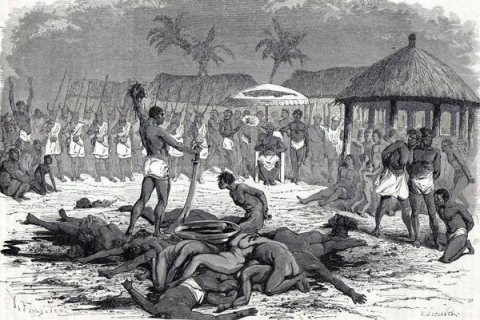
Purushamedha literally translates into Human sacrifice wherein Purusha means Man and Medha means Sacrifice. The word Naramedha (Nara=Man; Medha=Sacrifice) is used in scriptures other than the Vedas. Human sacrifice is not widely prevalent as it was banned since the British era. Although in the present age human sacrifices are rarely made, there can be no doubt of the existence of the practice formerly. But I am not talking about the prevalence of this practice although there have been some isolated incidents, I am talking about the scriptural sanctions of this practice. Unfortunately, such an evil practice has origins in the religious scriptures of Hindus. Numerous humans have fallen victim to this evil Hindu practice. There have been some isolated incidents of human sacrifice to Hindu goddess Kali in the present age,
It was only in 2014 that the National Crime Records Bureau (NCRB) started collecting data on human sacrifice. The statistics with the bureau reveal a disturbing picture: there were 51 cases of human sacrifice spread across 14 states between 2014 and 2016.
https://www.thequint.com/news/india/goddess-kali-worship-does-not-need-human-sacrifice
- India child killed in ‘human sacrifice’ ritual
http://www.bbc.com/news/world-asia-india-34409637 - Four-year-old boy ‘beheaded in human sacrifice witchcraft ritual in India’
http://www.telegraph.co.uk/news/worldnews/asia/india/11908176/Four-year-old-boy-beheaded-in-human-sacrifice-witchcraft-ritual-in-India.html - Indian cult kills children for goddess
https://www.theguardian.com/world/2006/mar/05/india.theobserver - Indian father kills his eight-month-old son with an axe to appease Hindu goddess of destruction and rebirth
http://www.dailymail.co.uk/news/article-2454853/Indian-father-kills-month-old-son-axe-appease-Hindu-goddess-destruction-rebirth.html - Five-year-old boy murdered as human sacrifice ritual in Andhra Pradesh; accused thrashed
http://indianexpress.com/article/india/india-news-india/five-year-old-boy-murdered-as-human-sacrifice-ritual-in-andhra-pradesh-accused-thrashed/
Archaeological evidence proves that human sacrifice was performed,
“‘Purushamedha Yagya’, sacrificing healthy and learned human male for political supremacy, was a tradition in the country. Concrete archaeological evidence of this kind of sacrifice has been found in Chhattisgarh’s neighbourhood.”
The report also shows that sometimes a human model was symbolically sacrificed. That may have been done on the basis of Asvalayana Srauta Sutra which recommends symbolically sacrificing a human figure and tying a snake, the report shows that an iron snake was also found in the excavation. It may be a substitute for literal human slaughtering. And the archaeological findings also prove that horses were sacrificed in Ashvamedha Yajna, as remains of horse were found in the excavation,
“Pravarasena-I during his time had earlier performed Ashwamedha Yagya also. The remains were found at Mansar during manganese mining in 1935. The charred bone remains of the horse recovered were preserved in London museum.”
Archaeological evidence from Kausambi also proves the slaughter of men in human sacrifice. Human bones and skull were found in an excavation at Kausabi,
“The references to Kausambi in early literature and epigraphical records have been collated by N. N. Ghosh (1935), B. C. Law (1939) and G. R. Sharma (1969). The earlier history and archaeology of the city have been discussed in chapters 6, 7 and 10. Periods 3-5 of the fortification wall belong to the time-span of this chapter. Period 3 was dated by Sharma to the period of the Mitra kings of Kausambi who, on grounds of palaeography and other historical considerations, have been assigned to the period from the 2nd to the 1st century BC (Sharma 1960). Again, ‘on numismatic grounds’, Sharma states, ‘rampart 5 seems to have been built by the Maghas, who made Kausambi their capita) in the second half of the 2nd century AD’ (Sharma 1960). This numismatic argument has also been supplemented by the evidence of inscribed terracotta seals, terracotta figurines and iron arrowheads. The rampart wall rises even now to an average height of 1.5 m from the level of the surrounding plain, with its towers touching the 21-23 m level (Fig. 11.4). There were eleven gateways in all, of which five, two each on the cast and north and one on the west, have been considered to be the principal ones, The road leading to each gate was flanked by two mounds, obviously watchtowers, which lay across the moat encircling the rampart (except, of course, on the river side). About a mile away from this complex, there is another ring of mounds which once might have encircled the city. The rampart (of mud and bunt-brick revetment) was extended in the third stage and an interesting discovery was that of an altar outside the eastern gate at the foot of the rampart. This altar is supposedly shaped like an eagle flying to the southeast and associated with a fireplace, animal and human bones including a human skull. Sharma (1960, chapters 8-10) has adduced a mass of literary material to suggest that certain details of its construction correspond to the fire altar prescribed for purushamedha or human sacrifice in ancient Indian ritualistic texts.” The Archaeology of Early Historic South Asia: The Emergence of Cities and States, p.298, By F. R. Allchin, George Erdosy, Cambridge University Press, 07-Sep-1995
Wendy Doniger also cites this in her book “On Hinduism”,
“There is, however, in addition to the textual references to human sacrifice, also physical evidence of its performance, such as archaeological remains of human skulls and other human bones at the site of fire-altars, together with the bones of other animals, both wild and tame (horse, tortoise, pig, elephant, bovines, goats and buffalos).” On Hinduism, p.217, By Wendy Doniger, OUP USA, 2014
Purushamedha was performed to gain prestige, prosperity, power, atonement of sins, and fulfill desires. The human victim was usually purchased from the family in lieu of a hundred or a thousand cows or horses. The man to be sacrificed was sometimes let loose before the sacrifice just like the horse in the horse sacrifice. While he was let loose, all his desires were fulfilled except for carnal desires. The human victim was tied to a pillar or pole then anointed with oil or other things and then he was either slaughtered or immolated in human sacrifice, human victim was also suffocated. As per Apastamba Srauta Sutra 20.24.2, this ceremony is to be performed only by a Brahmin or a Kshatriya. The killing of a Brahmin is called Brahmin slaughter in Hindu scriptures and it’s a major sin but in the Purushamedha the human victim can be a Brahmin also. Sankhayana Srautasutra 16.10.2 mentions that the victim can be a Brahmin or a Kshatriya also. Hindu scriptures also describe how the physical traits of the human victim should be, the human victim should be fit, not crippled, not black in complexion, etc. Taittriya Brahmana 3rd Kanda, Fourth Prapathaka, chapters 1-16 and Chapter 30 of Vajasaneyi Samhita (Yajurved) mentions the list of human victims that should be sacrificed while some scholars say that in the Purushamedha mentioned in Taittriyia Brahmana the victim is set free after the symbolic sacrifice. Some of the victims include paramour, flute blower, drum beater, maker of ointment, gatherer of wood, astrologer, fisherman, etc. The Kathyayana Srautasutra 16.1.14 adds that the man is to be slain in a screened shed. What is done with the flesh of the sacrificed man is not clear, the flesh of animals sacrificed in Ashvamedha and other sacrifices is to be eaten by priests and Sacrificers but that doesn’t seem to be the case with Purushamedha as consumption of human flesh is prohibited for Hindus. Kings used to offer their rival kings in human sacrifice, there is a reference of Jarasandha going to slaughter his rival kings in Purushamedha wherein he was stopped from doing so by Krishna, but Krishna didn’t prohibit Purushamedha there. He refused that such practice exists, he clearly denied the existence of this practice, which is mentioned in Mahabharata. A Srauta Sutra commands to offer rival kings if no one comes forward to be offered as a human victim. Human sacrifice may have not been performed by Vaishnavite Hindus, Human sacrifice may have been practiced mainly by the Shaivite Hindus as evident from Shaivite Puranas which give instructions on how to perform human sacrifice and most of the verses about human sacrifice are related to Shaivites.
According to Sankhayana Srautasutra 16.12.21-16.13.1-9, the man who has been chosen as the chief victim is killed (by suffocating), and ‘when he is quieted (i.e., killed), the Udgatar sings over him, standing near him, the Saman which is addressed to Yama (the god of death),’ and ‘the Hotar recites over him the Purusa-Narayana-hymn.’ Then, ‘When the man has been quieted, they cause the first consort of the Sacrificer to lie down near him,’ and ‘the Sacrificer addresses these two in the same manner (as in the horse sacrifice).’
According to Julius Eggeling, the Purushamedha mentioned in Sankhayana and Vaitana is a modern adaption intended to fill the gap between the sacrificial system which seemed to require a man but this doesn’t convince me. I am reproducing verses from Sankhayana and Vaitana Srauta Sutras which gives details on how Purushamedha is performed,
Sankhayana Srauta Sutra XVI, 10, 1 “Pragâpati, having offered the Asvamedha, beheld the Purushamedha: what he had not gained by the Asvamedha, all that he gained by the Purushamedha; and so does the sacrificer now, in performing the Purushamedha, gain thereby all that he had not gained by the Asvamedha. 2, 3. The whole of the Asvamedha ceremonial (is here performed); and an addition thereto. 4-8, First oblations to Agni Kama (desire), A. Dâtri (the giver), and A. Pathikrit (the path-maker). 9. Having bought a Brâhmana or a Kshatriya for a thousand (cows) and a hundred horses, he sets him free for a year to do as he pleases in everything except breaches of chastity. 10. And they guard him accordingly. 11. For a year there are (daily) oblations to Anumati (approval), Pathyâ Svasti (success on the way), and Aditi. 12. Those (three daily oblations) to Savitri in the reverse order. 13. By way of revolving legends (the Hotri recites) Nârasamsâni . . .–XVI, II, 1-33 enumerate the Nârasamsâni, together with the respective Vedic passages.–XVI, 12, 1-7. There are twenty-five stakes, each twenty-five cubits long . . .; and twenty-five Agnîshomîya victims. 8. Of the (three) Asvamedha days the first and last (are here performed). 9-11. The second (day) is a pañkavimsa-stoma one . . . 12. The Man, a Gomriga, and a hornless (polled) he-goat–these are the Prâgâpatya (victims). 13. A Bos Gaurus, a Gayal, an elk (sarabha), a camel, and a Mâyu Kimpurusha (? shrieking monkey) are the anustaranâh. 14-16. And the (other) victims in groups of twenty-five for the twenty-five seasonal deities . . . 17. Having made the adorned Man smell (kiss) the chanting-ground, (he addresses him) with the eleven verses (Rig-v. X, 15, 1-11) without ‘om,’–‘Up shall rise (the Fathers worthy of Soma), the lower, the higher, and the middle ones.’ 18. The Âprî verses are ‘Agnir mrityuh‘ . . . 20. They then spread a red cloth, woven of kusa grass, for the Man to lie upon. 21. The Udgâtri approaches the suffocated Man with (the chant of) a Sâman to Yama (the god of death).–XVI, 13, 1. The Hotri with (the recitation of) the Purusha Nârâyana (litany). 2. Then the officiating priests–Hotri, Brahman, Udgâtri, Adhvaryu–approach him each with two verses of the hymn (on Yama and the Fathers) Rig-v. X, 14, ‘Revere thou with offering King Yama Vaivasvata, the gatherer of men, who hath walked over the wide distances tracing out the path for many.’ 3-6. They then heal the Sacrificer (by reciting hymns X, 137; 161; 163; 186; 59; VII, 35). 7-18. Ceremonies analogous to those of the Asvamedha (cf. XIII, 5, 2, 1 seqq.), concluding with the Brahmavadya (brahmodya).–XVI, 14, 1-20. Details about chants, &c.; the fourth (and last) day of the Purushamedha to be performed like the fifth of the Prishthya-shadaha.” Tr. Julius Eggeling
Following two passages from Sankhayana Srauta Sutra also promotes necrophilia,
Sankhayana Srauta Sutra XVI.12.6-21 “There are twenty five victims to be immolated to Agni and Soma…Purusa (man), forsooth, consists of twenty five parts (or it is the twenty fifth). Thereby he makes him thrive by his own characteristic. The victims to be immolated to Prajapati are a man, a gomrga and a hornless he goat…The human victim, which has been adorned, they make smell the spot where the out of doors land is performed and (they praise it) with the eleven (verses) not joining the pranava ‘Let the nearer ones arise.’ The apri verses are “Agni, death” The hymn ‘Do not burn him’ he should insert in the adhrign formula in the same manner as (at the asvamedha). Now they spread out for the human victim a garment of kusa grass, a (cloth) of trpa bark, a red garment of silk threads. When it is ‘quieted’ the udgatr sings over it standing near it the saman addressed to Yama.” Tr. W. Caland
Sankhayana Srauta Sutra XVI.13.1-8 “And the hotr recites over it the purusa narayana (hymn). Now the principal priests hotr, brahman, udgatr and adhvaryu address to it each two of the verses of the hymn Him who has gone hence… When the human victim has been quieted, they cause the first consort of the sacrificer (king) to lie down near it. They cover them both with the upper garment.” Tr. W. Caland
The most famous story about human sacrifice in Hinduism is that of Shunashepa. I am reproducing the summary of the story which I have taken from Wikipedia,
“King Harishchandra of the Ikshvaku dynasty had 100 wives, but no son. On advice of the sage Narada, he prayed to the deity Varuna for a son. Varuna granted the boon, in exchange for an assurance that Harishchandra would make a sacrifice to Varuna in the future. As a result of this boon, a son named Rohita (or Rohitaswa) was born to the king. After his birth, Varuna came to Harishchandra and demanded that the child be sacrificed to him. The king postponed the sacrifice multiple times citing various reasons, but finally agreed to it when Rohita became an adult. Rohita refused to be sacrificed and escaped to forest. An angry Varuna afflicted Harishchandra with a stomach illness. Rohita intermittently visited his father, but on advice of Indra, never agreed to the sacrifice.
In the sixth year of wandering in the forest, Rohita met a starving Brahmin named Ajigarta Sauyavasi, a descendant of Angiras. Ajigarta had three sons. Rohita offered Ajigarta a hundred cows in exchange for one of his sons to be sacrificed to Varuna in his place. Ajigarta agreed to the offer. He didn’t want his eldest son to be sacrificed, and his wife didn’t want their youngest son to be sacrificed. So, Shunahshepa — the middle son — was chosen for the sacrifice. Rohita then gave a hundred cows to Ajigarta, and took Shunahshepa and Ajigarta to the royal palace.
Varuna agreed to the replacement on the basis that a Brahmin was a worthy substitute for a Kshatriya. King Harishchandra combined the sacrifice with his own Rajasuya ceremony. Four priests were called to conduct the sacrifice: Ayasya (the udgatr), Jamadagni (the adhvaryu), Vashistha (the brahman) and Vishvamitra (the hotar). However, all of them refused to bind Shunahshepa to the sacrificial post. Ajigarta then offered to bind his son for another hundred cows. Rohita accepted the offer, and Ajigarta bound Shunahshepa to the post. However, the priests refused to slaughter him. Ajigarta then offered to sacrifice his own son in exchange for another hundred cows. The prince agreed to his demand. As Ajigarta readied to kill his own son, Shunahshepa prayed to the Rigvedic deities. With his last hymn, which invoked Ushas (the deity of the dawn), his bonds were loosened and King Harishchandra was also cured of his illness.
Vishvamitra, one of the priests, offered to adopt Shunahshepa as his eldest son. Reviling his own father Ajigarta as a Shudra, Shunahshepa agreed. Vishvamitra gave him the name Devarata (“deity-given”). Half of Vishvamitra’s sons – the younger ones – accepted Devarata as their elder brother. However, the elder ones refused to accept the adoption. Vishvamitra then cursed their offspring to be exiled out of Aryavarta. According to the Aitareya Brahmana, the descendants of these 50 sons included the Andhras, the Mutibas, the Pulindas, the Pundras, the Shabaras, and the various Dasyu tribes.”
This story is also mentioned in Rig Veda but it doesn’t give much detail, but supplementary texts do elaborate this story, it talks about the freeing of Shunashepa from the slaughter. Human sacrifice of Shunashepa proves that human sacrifice existed in the Vedic period and the Vedic god Varuna asking for a human sacrifice proves that it was very much Vedic.
Rig Veda 5.2.7 Thou from the stake didst loose e’en Śunaḥśepa bound for a thousand; for he prayed with fervour. So, Agni, loose from us the bonds that bind us, when thou art seated here, O Priest who knowest.

Rig Veda 1.24.13 Bound to three pillars captured Śunaḥśepa thus to the Āditya made his supplication. Him may the Sovran Varuṇa deliver, wise, ne’er deceived, loosen the bonds that bind him.

These Rigvedic verses are further elaborated in Aitareya Brahmana,
Aitareya Brahmana Book 7, Chapter 3, Para 14 “Narada then told him, “Go and beg of Varuna the king, that he might favour you with the birth of a son (promising him at the same time) to sacrifice to him this son when born.” He went to Varuna the king, praying, “Let a son be born to me; I will sacrifice him to thee.” Then a son, Rohita by name, was born to him. Varuna said to him, “A son is born to thee, sacrifice him to me.” Harischandra said, “An animal is fit for being sacrificed, when it is more than ten days old. Let him reach this age, then I will sacrifice him to thee….Varuna then said, “he has now received the armor, sacrifice him to me.” After having thus spoken, he called his son, and told him, “Well, my dear, to him who gave thee unto me, I will sacrifice thee now.” But the son said, “No, no,” took his bow and absconded to the wilderness, where he was roaming about for a year.” Martin Haug
This story is also mentioned in Devi Bhagavatam, Aitareya Brahmana (7.13-18), Brahma Purana 9.65-68, the story is repeated in the Balakanda (1.61) of Valmiki’s Ramayana and a couple of Puranas but none of those texts prohibits human sacrifice. Manu Smriti instead says that Ajigarta the father of Shunashepa made no sin in doing that,
Manu Smriti 10.105. Agigarta, who suffered hunger, approached in order to slay (his own) son, and was not tainted by sin, since he (only) sought a remedy against famishing.
According to some scholars, Ajigarta was going to kill his son for eating him as Ajigarta was starving, but this version contradicts other scriptures. Vishwamitra also didn’t prohibit this practice he instead asked his sons to be sacrificed. Vishwamitra asked his sons if any of them were willing to replace Shunahshepa in the sacrifice. His sons rejected the demand with scorn, stating that it would be equivalent to eating dog meat. Angered at their impudence, Vishvamitra cursed his sons to be reborn as outcast dog-meat eaters for a thousand years, just like Vashistha’s sons.
Valmiki Ramayana, Bala Kanda 1, chapter 62, verses 12-17 “You all have done very good pious deeds and you all abide by probity. Hence, you bestow appeasement to Fire-god on your becoming the ritual-animals of king Ambariisha in lieu of this boy Shunashepa. As a result, Shunashepa will have protectors, Vedic-ritual will be unimpeded, gods will be oblated, and my word too will be actualised.’ Thus Vishvamitra said to his sons. But on hearing the saying of the sage, oh, Rama, the best of men, Madhushyanda and the other sons of Vishvamitra said this, haughtily and disparagingly. On sacrificing your own sons how can you save another’s son, oh, lordly father, we deem this as a wrongdoing and as good as dog’s meat in a dinner.’ Thus the sons of Vishvamitra replied their father. On listening that saying of his sons that eminent sage Vishvamitra started to curse them while fury reddened his eyes. You all have not only transgressed my word, but pertly replied me in an impudent manner which is abhorrent and hair-raising, and recriminatory according to probity. You all will be whirling around the earth totally for a thousand years taking birth in the race that subsists on dog’s meat, like the sons of Vashishta.’ Thus Vishvamitra cursed his sons.” Tr. Shri Desiraju Hanumanta Rao
So human sacrifice is prohibited in none of the scriptures instead they justify human sacrifice by saying that Agigarta was not tainted by sin, Vishwamitra ordered his sons to be slaughtered in the sacrifice so that Vedic ritual will be unimpeded and gods will be pleased. The sentence “you bestow appeasement to Fire-god on your becoming the ritual-animals” shows that Shunashepa was going to be immolated in this human sacrifice, as the victim was killed in various ways like suffocation, immolation, or slaughtering.
Srimad Bhagavatam also mentions this story but it’s self-contradictory, in one place it says that Shunashepa was let free which is in conformity with other scriptures but in another place, it says that a man was slaughtered in the human sacrifice by king Harishchandra,
Srimad Bhagavatam 9.7.21-23 “Thereafter, the famous King Hariścandra, one of the exalted persons in history, performed grand sacrifices by sacrificing a man and pleased all the demigods. In this way his dropsy created by Varuṇa was cured. In that great human sacrifice, Viśvāmitra was the chief priest to offer oblations, the perfectly self-realized Jamadagni had the responsibility for chanting the mantras from the Yajur Veda, Vasiṣṭha was the chief brahminical priest, and the sage Ayāsya was the reciter of the hymns of the Sāma Veda. King Indra, being very pleased with Hariścandra, offered him a gift of a golden chariot. Śunaḥśepha’s glories will be presented along with the description of the son of Viśvāmitra.” Tr. Swami Prabhupada
Swami Prabhupada writes on verse 20,
“It appears that in those days a man could be purchased for any purpose. Hariścandra was in need of a person to sacrifice as the animal in a yajña and thus fulfill his promise to Varuṇa, and a man was purchased from another man for this purpose. Millions of years ago, animal sacrifice and slave trade both existed. Indeed, they have existed since time immemorial.” Swami Prabhupada on Srimad Bhagavatam 9.7.20 http://vanisource.org/wiki/SB_9.7.20
There is a similar version of Shunashepa’s human sacrifice which is mentioned in Padma Purana,
Padma Purana IV.12.6-22 “[Galava said:] O king, I shall tell you in brief the cause of a son’s birth about which you have asked me. Listen attentively. O best king, perform the sacrifice called Naramedha. Then you will have progeny endowed with all (good characteristics). The king said: O preceptor, O brahmana, tell me by bringing what kind of man I shall perform the great human sacrifice, the best among sacrifices. Galava said: If a man has a handsome body, a charming face and is proficient in all sacred texts, then he is fit for sacrifice. He who is crippled, has a black complexion, is a fool, would not be fit (for sacrifice)…” Tr. N.A. Deshpande
So instead of sage Narada, we read here that Sage Galava had recommended Human Sacrifice to King Dinanath. So Ved Vyasa, Sage Narada, and Sage Galava recommended Human Sacrifice hence which is a commandment and can’t be rejected by Hindus.
Srimad Bhagavatam prohibits Human Sacrifice to Kali and Bhairava but Agni Purana gives instructions on how to perform Human Sacrifice to Kali and Bhairava. Following verses from Agni Purana gives instructions on how to perform Homa with flesh, blood and bones of human to ensure victory in battle,
Agni Purana 125.46-50 ” ‘Om obeisance to the greatest Bhairava (Maha Bhairava) the fierce jawed, yellow eyed, diabolical looking one who wields a sword and a trident in his hands, Vousat.’ The earth should be made permeated with the above Mantra, which would hold any abeyance the arms of the enemy’s forces. Now I shall speak about the fire rite (Agnikaryya) which should be performed at the commencement of a battle for ensuring victory. In the night of the votary should resort to a cremation ground, and light up a fire with the logs of wood found therein unto which he should perform hundred and eight times the Homa ceremony with poison and human flesh and blood, and broken bones of dead bodies by uttering the name of his enemy.” Tr. M.N. Dutt
Following are the instructions given for performing homa to Camundi
Garuda Purana I.38.8 “With the great flesh (human flesh) coated with the three sweet things homa shall be performed one thousand and eight times repeating each letter one thousand eight times. Or merely gingelly seeds coated with trimadhura can be used for homa.” Tr. J.L. Shastri
In another verse of Agni Purana, a goddess is supplicated to relish the flesh of enemy humans,
Agni Purana 134.1-6 “Kill and kill, Oh thou goddess who dost fondly relish human flesh and blood, trample down and trample down, Om, pierce through and pierce through, Om slay and slay…” Tr. M.N. Dutt
A similar thing is also mentioned in Agni Purana 145.1-4. Another verse from Agni Purana says,
Agni Purana 311.31-33 “An image or a picture of the goddess Tvarita, should be the object of worship in the present instance, or her presence should be simply invoked on the sacred cushion, on such an occasion. The rites of Japa and Homa should be performed a hundred thousand, or a ten thousand times, in connection with each worship, or a hundred thousand libations should be poured on the fire, after having repeated the Mantra, as above indicated. The libations should contain the particles of buffalo, sheep, or human flesh, or handsful of barley, sesamum, fried paddy, or Vrihi soaked in the washings of wheat, or should consist of clarified butter containing the slices of a Bael fruit.” Tr. M.N. Dutt
Agni Purana 314.9-12 “the verse should be written with a pen of cow’s quill, and in a composition made of collyrium, the gum of a Nimva tree, poison, and the marrow and blood of a human victim. A cremation ground, or a crossing of four roads, should be the place where the spell should be secretly practiced. The charm should be either placed underneath a pitcher, or deposited inside an anthill, or should be hung on the bough of a Vibhitaka tree. The spell, in question should be looked upon as the destroyer of one’s opponents of all demoninations.” Tr. M.N. Dutt
Devas propitiating the Sakti by means of human flesh,
Brahmanda Purana Lalita Mahutmya 12.56-67 “Even if we flee, there is no place of refuge for us anywhere. Hence, we shall make a sacrificial pit one Yojana in breadth. Let it be splendid and dug perfectly well. We shall prepare the sacrificial fire in accordance with the injunction of a Mahayaga. O Suras, we shall then worship the greatest Sakti by means of Mahamamsa (great flesh i.e. human flesh). We shall become Brahman or we will be able to enjoy heaven.’ On being told thus, the Devas with Indra as their leader duly performed Homa by chopping off the flesh to the chanting of Mantras.” Tr. G.V. Tagare
In Krishna Yajur Veda buying the head of a dead man for twenty-one beans is prescribed.
Krishna Yajur Veda 5.1.8 With twenty-one beans he approaches the head of the man; beans are impure, the man’s head is impure; verily by the impure he redeems its impurity and making it pure takes it. There are twenty-one; man is composed of twenty-one parts; (verily they serve) to obtain man. The man’s head is impure as bereft of the breaths; he deposits (it near) an ant-heap pierced in seven places; the breaths in the head are seven; verily he unites it with the breaths, to make it pure. Of all those [1]
The same is mentioned in Katha Samhita 19.8; 20.8
Krishna Yajur Veda 5.2.9.1 if he desire of a man, ‘May he eat food that fails not’, he should put it down full; verily he eats food that fails not. The man accords a thousand of cattle, the other animals a thousand; in the middle he puts down the head of the man, to give it strength. In the pan he puts (it) down; verily he makes it attain support; the head of the man is impure as devoid of breaths; the breaths are immortality
The Vaitana Srauta Sutra talks about purchasing a man for a thousand cows and if no one comes forward then he should conquer his nearest enemy and sacrifice him.
Vaitana Srauta Sutra XXXVII, 10. “The Purushamedha (is performed) like the Asvamedha . . . 12. There are offerings to Agni Kama, Dâtri, and Pathikrit. 13. He causes to be publicly proclaimed, ‘Let all that is subject to the Sacrificer assemble together!’ 14. The Sacrificer says, ‘To whom shall I give a thousand (cows) and a hundred horses to be the property of his relatives? Through whom shall I gain my object?’ 15. If a Brâhmana or a Kshatriya comes forward, they say, ‘The transaction is completed.’ 16. If no one comes forward, let him conquer his nearest enemy, and perform the sacrifice with him. 17. To that (chosen man) he shall give that (price) for his relatives. 18. Let him make it he publicly known that, if any one’s wife were to speak, he will seize that man’s whole property, and kill herself, if she be not a Brâhmana woman. 19. When, after being bathed and adorned, he (the man) is set free, he (the priest) recites the hymns A.V. XIX, 6; X, 2.-20. For a year (daily) offerings to Pathyâ Svasti, Aditi, and Anumati. 21. At the end of the year an animal offering to Indra-Pûshan. 22. The third day is a Mahâvrata. 23. When (the man) is bound to the post, he repeats the three verses, ‘Up shall rise’ . . .; and when he is unloosened, the utthâpanî-verses. 24-26. When he is taken to the slaughtering-place (the priest repeats) the harinî-verses; when he is made to lie down, the two verses, ‘Be thou soft for him, O Earth’; and when he has been suffocated, (he repeats) the Sahasrabâhu (or Purusha Nârâyana) litany, and hymns to Yama and Sarasvatî–XXXVIII, 1-9 treat of the subsequent ceremonies, including the recitation, by the Brahman, of hymns with the view of healing the Sacrificer.” Tr. Julius Eggeling
Verses from Srimad Devi Bhagavatam shows that human was immolated in Purushamedha, It’s about Shunashepa,
Devi Bhagavatam 7.15.8-10. O Deva of the Devas! I will obey your order no doubt and I will perform your sacrifice according to the Vedic rites and with profuse Daksinâs (remuneration to priests, etc.) But, when in a sacrifice human beings are immolated as victims, both the husband and wife are entitled to the ceremony…” Tr. Swami Vijnananda
Human sacrifice in the Purusha Sukta of Vedas is symbolic that talks about God sacrificing Purusha which is considered a spirit or god by Hindu scholars. But in Krishna Yajur Veda the sacrifice includes actually killing the man. Satapatha Brahmana explains human sacrifice both literally and symbolically just as it does with Ashvamedha Yajna the horse sacrifice. Human sacrifice also occurs in Puranas, especially in the Kalika Purana. Human sacrifice is hardly forbidden in Hindu Puranas which we shall evaluate in this article. It seems like Human sacrifice was not as widely practiced as Ashvamedha although Hindu scriptures consider Naramedha/Purushamedha as much more beneficial than Ashvamedha. Sankhayana Srauta Sutra says that Purushamedha is performed to gain what one didn’t gain by performing the Ashvamedha Yajna. Hindu scriptures also talk about other rituals which bring you blessings and benefits equivalent to Human sacrifice.
Hindu scriptures also mention priests’ sacrificial fees. It’s mentioned in Satapatha Brahmana,
Satapatha Brahmana 13:6:2:18-19 “Now as to the sacrificial fees. What there is towards the middle of the kingdom other than the land and the property of the Brâhmana, but including the men, of that the eastern quarter belongs to the Hotri, the southern to the Brahman, the western to the Adhvaryu, and the northern to the Udgâtri; and the Hotrikas share this along with them. And if a Brâhmana performs the sacrifice, he should bestow all his property in order to obtain and secure everything, for the Brâhmana is everything, and all one’s property is everything, and the Purushamedha is everything.”
The Mahabharata in one place denies the existence of Human sacrifice but in another section recommends Human sacrifice for atonement for sins. Ved Vyasa speaks to Yudhisthira,
Mahabharata Asvamedha Parva 14, Section 3, Verses 4-8 “O Yudhishthira, those that commit sins, can always free themselves from them through penance, sacrifice and gifts. O king, O foremost of men, sinful people are purified by sacrifice, austerities and charity. The high-souled celestials and Asuras perform sacrifices for securing religious merit; and therefore sacrifice are of supreme importance. It is through sacrifices that the high-souled celestials had waxed so wondrously powerful; and having celebrated rites did they vanquish the Danavas. Do thou, O Yudhishthira, prepare for the Rajasuya, and the horse-sacrifice, as well as, O Bharata, for the Sarvamedha and the Naramedha.” Tr. K.M. Ganguli
Another Mahabharata verse suggests that by performing Human Sacrifice, Hindus attain higher status perhaps in the hereafter,
Mahabharata Shalya Parva 9, Section 50 “He then saw him in the regions of those foremost of men that perform the horse-sacrifice and the sacrifice in which human beings are slaughtered.” Tr. K.M. Ganguli
Jain saint censuring the sacrifices of Vedas and telling its evils to king Vena,
Padma Purana II.37.32b-42 “I shall tell you another fierce act (mentioned) in the Vedas. When a guest goes (i.e. arrives) to the house, a brahmana (kills and) cooks (the flesh of) a great bull; or O king of kings, he would feed the guest (with the flesh of) a goat. (They kill) a horse in a horse-sacrifice, and a bull in a bull-sacrifice; a man in a human sacrifice and goats in a Vajapeya sacrifice…” Tr. N.A. Deshpande
Vamana Purana mentions that a righteous king performed human sacrifice for a hundred and thousand times,
Vamana Purana 50.15 “There, wherein the eminent king Gaya had performed the horse sacrifice a hundred times completed with the payment of liberal presents, the human sacrifice a hundred times and a thousand times as also the Rajasuya sacrifice a thousand times.” Tr. Ananda Swarup Gupta
Satapatha Brahmana has details about Human Sacrifice,
Satapatha Brahmana 7:5:2:13-14 He then lifts up the human head–he thereby exalts it–with, ‘Giver of a thousand thou art: for a thousand thee!’ a thousand means everything: thus, ‘the giver of everything, for everything (I bestow) thee!’. He then puts them (the heads) in (the fire-pan), first (that of) the man–having taken possession of the man by strength he sets him up;–the man in the middle; on both sides the other victims: he thus sets the man, as the eater, in the midst of cattle; whence man is the eater in the midst of cattle. [22-23] These are the victims; separately he puts them down, separately he ‘settles’ them, and separately he pronounces the Sudadohas on them; for separate from one another are those animals. He then offers on the human head, sacrifice is offering: he thus makes man the one among animals fit to sacrifice; whence man alone among animals perform sacrifice.
Following verses from Satapatha and Aitareya Brahmana show how the essence of sacrifice went from man to animals,
Satapatha Brahmana 1.2.3.6-7; Aitareya Brahmana Book 2, Para 8 “At first, namely, the gods offered up a man as the victim. When he was offered up, the sacrificial essence went out of him. It entered into the horse. They offered up the horse. When it was offered up, the sacrificial essence went out of it. It entered into the ox. They offered up the ox. When it was offered up, the sacrificial essence went out of it. It entered into the sheep. They offered up the sheep. When it was offered up, the sacrificial essence went out of it. It entered into the goat. They offered up the goat. When it was offered up, the sacrificial essence went out of it. It entered into this earth. They searched for it, by digging. They found it (in the shape of) those two (substances), the rice and barley: therefore even now they obtain those two by digging; and as much.”
Following Satapatha Brahmana verses mentions 5 Pashus which were offered in sacrifice,
Satapatha Brahmana 6.2.1.18. A man (purusha) he slaughters first, for man is the first of animals; then a horse, for the horse comes after man; then a bull, for the bull (or cow) comes after the horse; then a ram, for the sheep comes after the cow; then a he-goat, for the goat comes after the sheep: thus he slaughters them according to their form, according to their excellence.
Satapatha Brahmana criticizes those who procure the heads of the five victims without sacrificing them, for such sacrificers will become mortal carcasses, like Asadhi Sausromateya, who died quickly after such heads had been put into his fire altar.
Satapatha Brahmana 6:2:1:37; 39 Now some, having in that way obtained those heads, put them on (the fire-altar), thinking, ‘Either way are they animals.’ But they (who do this) become mortal carcases, for unpropitiated are those (heads) of theirs. In this way, indeed, they did put them on for Ashâdhi Sausromateya; but quickly indeed he died after that. Some, again, make earthen ones, thinking, ‘Passed away, forsooth, are these animals, and this earth is the shelter of all that has passed away: thus whither those animals have gone, from thence we collect them.’ Let him not do so, for whoso knows not both the practice and theory of these (victims), for him let them be passed away. Let him slaughter those very five victims, as far as he may be able to do so; for it was these Pragâpati was the first to slaughter, and Syâparna Sâyakâyana the last; and in the interval also people used to slaughter them. But nowadays only these two are slaughtered, the one for Pragâpati, and the one for Vâyu. The theory of these two is now (to be) told.
So above verses from Satapatha Brahmana leaves no doubt that Purushamedha included the actual slaying of humans. The following verse from Satapatha Brahmana says that Manu’s wife was sacrificed,
Satapatha Brahmana 1:1:4:15-16 These two said, ‘God-fearing, they say, is Manu: let us two then ascertain!’ They then went to him and said: ‘Manu! we will sacrifice for thee!’ He said: ‘Wherewith?’ They said: ‘With this bull!’ He said: ‘So be it!’ On his (the bull’s) being killed the voice went from him. It entered into Manâvî, the wife of Manu; and when they heard her speak, the Asuras and Rakshas were continually being crushed. Thereupon the Asuras said to one another: ‘Hereby even greater evil is inflicted on us, for the human voice speaks more!’ Kilâta and Âkuli then said: ‘God-fearing, they say, is Manu: let us then ascertain!’ They went to him and said: ‘Manu! we will sacrifice for thee!’ He said: ‘Wherewith?’ They said: ‘With this thy wife!’ He said: ‘So be it!’ And on her being killed that voice went from her.
The Karpûrâdi-Stotra which is also known as Hymn to Kali says,
Karpûrâdi-Stotra verse 19 “O DARK One, wondrous and excelling in every way, becomes the accomplishment, of those worshippers who living in this world freely make offering to Thee in worship of the greatly satisfying flesh, together with hair and bone, of cats, camels, sheep, buffaloes, goats, and men.” Tr. Arthur Avalon (Sir John Woodroffe)
Hindu scriptures also give instructions about offering Human flesh in sacrifices. The Sanskrit word Mahamasa is used which Hindu scholars have translated as human flesh. As far as my knowledge is concerned the flesh could be obtained by killing a human or by taking the flesh of a dead human. But since Hindus practice cremation so there’s more possibility that a human being was killed to obtain the flesh for sacrifices.
I don’t have a complete version of Kalika Purana, I have an abridged version of Kalika Purana translated by Biswanaryan Shastri so some points maybe missing from the following passage. Kalika Purana explicitly sanctions human sacrifice,
Kalika Purana chapter 35, verses 10-17 “The middle portion of that Sarabha-body, assumed by the great Samkara, turned into Bhairava, the wearer of human skull, terrible and inaccessible. They make offerings of (human) flesh and brain, mixed with fat, into the fire after these were put on a human skull (brahmakapala) and worship gods with wine. Human flesh is their oblation in sacrifice (they offer human sacrifice), blood is their drink, and wine is the means for the completion of sacrifice (yajna); they wear human skull in a curious way. They always wear tiger skins marked by three lines with dirt, are under the vow of fulfilling the austerity, called kapalavrata (doing with the human skull), and they behave like this. Kapala Bhairava (Bhairava with a human skull) is their god for worshipping. Bhairava, who resides in the crematorium is known by the epithet Maha Bhairava. He, with eighteen hands, and red eyes resembling the rising sun in radiance, always indulges in sexual dalliance with a host of female consorts, headed by terrible Kali. Bhairava always eats the human flesh which is being burnt just at the moment, wears a garland of human hands dangling from his neck, his body is always besmeared with sandal paste, while his seat is the human corpse, his face is large, the lips are thick, the feet and the body are thick and short; he is always in an amusing mood; he beats a drum and utters loud cries.” Tr. Biswanarayan Shastri
Jan E.M. Houben, Karel Rijik van Kooik wrote,
“Blood sacrifice, even human sacrifice, is elaborately described in the Kalika Purana [Kalika Purana 67, 68-90. Edition Sastri 1972), a Northeast-Indian work dating to the 11th century (Kooij 1972:3). Rituals win which blood from of one’s throat is offered, or pieces of one’s own flesh, or even one’s own body are mentioned in this text [Kalika Purana 67, 155-168. Edition Sastri 1972]. A variant of the navakhanda-rite mentioned above is described in the chapter on ‘blood-sacrifice’. The text mentions a special oblation to Durga which is to be given on the Mahanavami, ‘the great ninth day’. This sacrifice is called the offering of the flesh and blood from eight parts of the worshipper’s own body. A man who presents an oblation like this, the text says, will obtain the destruction of enemies [Kalika Purana 67, 151-164. Edition Sastri 1972]. Self-decapitation is not part of this rite. However, head offerings are mentioned in particular in connection with the worship of Durga, and also with rituals which took place at cremation places. Several names of fearsome deities which are usually associated with Tantric Buddhism, are mentioned in this work (Kooij 1974), such as Heruka, ekajata and Ugratara. They must have been deities who were at home in Tantric Buddhism and Hinduism, and who were associated with this kind of rites. The text of Kalikapurana makes it very clear that human sacrifice is considered as an ‘exceedinly great oblation’ [Kalika Purana 55, 3-6. Edition Sastri 1972], which isn only permitted when the country is in great danger and war is expected. The sacrifice can only be carried out with the official permission of the king [Kalika Purana 67, 116-117. Edition Sastri 1972.”
Violence Denied: Violence, Non-Violence and the Rationalization of violence in South Asian Cultural History, page 269, by Jan E.M. Houben, Karel Rijik van Kooij, BRILL, 1999
David Kinsley wrote,
“The Kalika-purana devotes a whole chapter to sacrifices acceptable to the Devi and includes human beings as particularly pleasing to her (71.73). A goddess named Kesai Khati (eater of raw flesh) was worshiped in Assam, and sometimes human sacrifices were made to her. The Manimekalai, a Tamil epic, describes the temple of a goddess which has an altar surrounded by posts from which human heads are hung…The Kalika-purana says that the Devi is satisfied when her devotee offer flesh from near their hearts (71.74 ff.)…In the Devi-mahatmya two devotees of the Devi petion her to grant them boons, and as part of their spiritual exercises they offer their own blood and pieces of their flesh (13.8).”
Hindu Goddesses: Visions of the Divine Feminine in the Hindu Religious Tradition, page 145, by David Kinsley, Published by Motilal Banarsidass, 1998
I am quoting Human Sacrifice mentioned in Rudhir Adyaya of Kalika Purana translated into English by Mr. W. C. Blaquiere which I have taken from Dr. B.R. Ambedkar’s book ‘Riddles in Hinduism’ Riddle no. 15 : How did the brahmins wed an ahimsak god to a bloodthirsty Goddess?
“By a human sacrifice attended by the forms laid down, Devi is pleased one thousand years and by sacrifice of three men, one hundred thousand years. By human flesh, Camachya, Chandica, and Bhairava who assumes my shape, are pleased one thousand years. An oblation of blood which has been rendered pure by holy texts, is equal to ambrosia; the head also afford much delight to the Goddess Chandica. Let therefore the learned when paying adoration to the Goddess, offer blood and the head, and when performing the sacrifices to fire, make oblations of flesh.”
“Let a human victim be sacrificed at a place of holy worship, or at a cemetery where dead bodies are burried. Let the oblation be performed in the part of the cemetery called Heruca, which has been already described, or at a temple of Camachya, or on a mountain. Now attend to the mode.”
“The cemetery represents me, and is called Bhairava, it has also a part called Tantarange; the cemetery must be divided into these two division, and a third called Heruca.”
“The human victim is to be immolated in the east division which is sacred to Bhairava, the head is to be presented in the south division, which is looked upon as the place sculls sacred to Bhairavi, and the blood is to be presented in the west division, which is denominated Heruca.”
“Having immolated a human victim, with all the requisite ceremonies at a cemetery or holy place, let the sacrificer be cautious not to cast eyes upon the victim.”
“Let the head and blood of a human victim be presented on the right side of Devi, and the sacrificer address her standing in front. Let the head and blood of birds be presented on the left and the blood of a person’s own body in front. Let the ambrosia proceeding from the heads of carnivorous animals and birds be presented on the left hand. As also the blood of all aquatic animals.”
“If a human sacrifice is performed, without the consent of the prince, the performer incurs sin. In cases of imminent danger or war, sacrifices may be performed at pleasure, by princes themselves and their ministers, but by none else.”
“The day previous to a human sacrifice, let the victim be prepared by the text Manastac, and three Devi Gandha Sucthas, and the texts Wadrang; and by touching his head with the axe, and besmearing the axe with sandal &c., perfumes, and then taking some of the sandal, &c., from off the axe, and besmearing the victim’s neck therewith.”
“Having secured the victim with cords, and also with (Mantras) let him strike off the head, and present it to Devi, with due care. Let him make these sacrifices in proportion to the increase or decrease of his enemies, chopping off the heads of victims for the purpose of bringing destruction on his foes, infusing, by holy texts, the soul of the enemy into the body of the victim, which will when immolated, deprive the foe of life also.”
https://www.mea.gov.in/Images/CPV/Volume4.pdf
Volume 4, see page number 118
RITUALS EQUAL TO HUMAN SACRIFICE
Mahabharata Vana Parva 3, Section 84 Arriving next at the well of Tamraruna, that is frequented by the gods, one acquireth, O lord of men, the merit that attaches to human sacrifice.
Mahabharata Asvamedha Parva 13, Section 25 He that bathes in Analamva or in eternal Andhaka, or in Naimisha, or the tirtha called Swarga, and offers oblations of water to the Pitris, subduing his senses the while, acquires the Merit of a human sacrifice
Narada Purana I.22.19 “O leading sage, he who performs the monthly fasts eight times, shall attain five times the benefit of sacrifice called Naramedha (Human sacrifice).” Tr. G.V. Tagare
Padma Purana I.59.187-191a “Aditya (i.e. the Sun) well-settled in the twelve mouths is always pleased with him who puts a rudraksa with twelve mouths round his neck. He quickly obtains the fruit which one gets by a cow-sacrifice or a human sacrifice, and deadly weapons are warded off.” Tr. N.A. Deshpande
Jan N. Bremmer wrote about human sacrifice in Hinduism,
“It is clear that the central role of the human head (and the four animal heads) in the piling up of the fire-altar presupposes sacrificial slaughter of some sort. According to the Srautasutras of the Black Yajurveda, the human head should be cut off of a ksatriya or vaisya killed by an arrow or lightning [Apastamba Srauta Sutra 16.6.2-3], after which it has to be covered with clay and set aside. The tradition of the White Yajurveda is more explicit that this ritual requires a human sacrifice. The Satapathabrahmana (6.2.12) unambiguously declares that a ‘man (purusa should be sacrificed first, for man is the first of the sacrificial animals (pasu).’ The Katyayana Srautasutra (16.1.17) states that the victim, a vaisya or rajanya, should be suffocated in a special secluded place, after which his head is taken, though it allows the option that a head of gold or clay is used as a substitute (ibid. 16.1.18) The bodies of the four animal victims are thrown into the water from where the clay is taken to make the bricks.”
If Purushamedha was only symbolic then why the word Medha is used? If this practice was symbolic then it should’ve had another name, is it a mere coincidence that the word Purushamedha is similar to Ashvamedha where a horse is slaughtered, and Gomedha where a cow is slaughtered? Hindu apologists try to reinterpret Purushamedha by saying that the victim was only symbolically sacrificed and it was not an actual slaying. It’s true that fire was carried around the human victim and then the victim was set free in another symbolic sacrifice but the very scripture which says this also talks about actually slaying the victim. The story of Shunashepa proves that it was an actual slaying of a man in Purushamedha. Hindu texts talking about killing the human victim by cutting off his head, immolating it, strangling him, etc., also prove that Purushamedha/Naramedha did include the slaying of the human victim. Textual references, as well as archaeological evidence proves that human was slaughtered in this sacrifice. Hindu apologists should be brave enough to accept the evils in Hinduism after all Hindus now claim that they are progressive.
So Hindu gods are nothing but bloodthirsty monsters. It’s a religion that asks for humans to be slaughtered, it’s a religion of the past of the barbarians and unfit to exist in the present age and a religion that cannot be eternal is to be rejected. By allowing barbaric practice like human sacrifice, Hinduism proved that it’s not suitable for the present age and it’s a reflection of the time it was founded.
REFERENCES
Satapatha Brahmana translated by Julias Eggeling from the volume “The sacred books of the east”
The Strange World of Human Sacrifice, p.184, by Jan N. Bremmer, Peeters Publishers, 2007
On Hinduism, By Wendy Doniger, OUP USA, 2014
Proceedings of the American Philosophical Society Vol. 107, No. 2 (Apr. 15, 1963), pp. 177-182
The Land of the Lingam by Arthur Miles
Mahabharata translated by Kisari Mohan Ganguli available at sacred-texts.com
Srimad Bhagavatam translated by Swami Prabhupada
Valmiki Ramayana available at valmikiramayan.net
Rig Veda translated into English by Ralph T.H. Griffith
Various Puranas published by Motilal Banarsidass publications
Riddles in Hinduism by Dr. B.R. Ambedkar